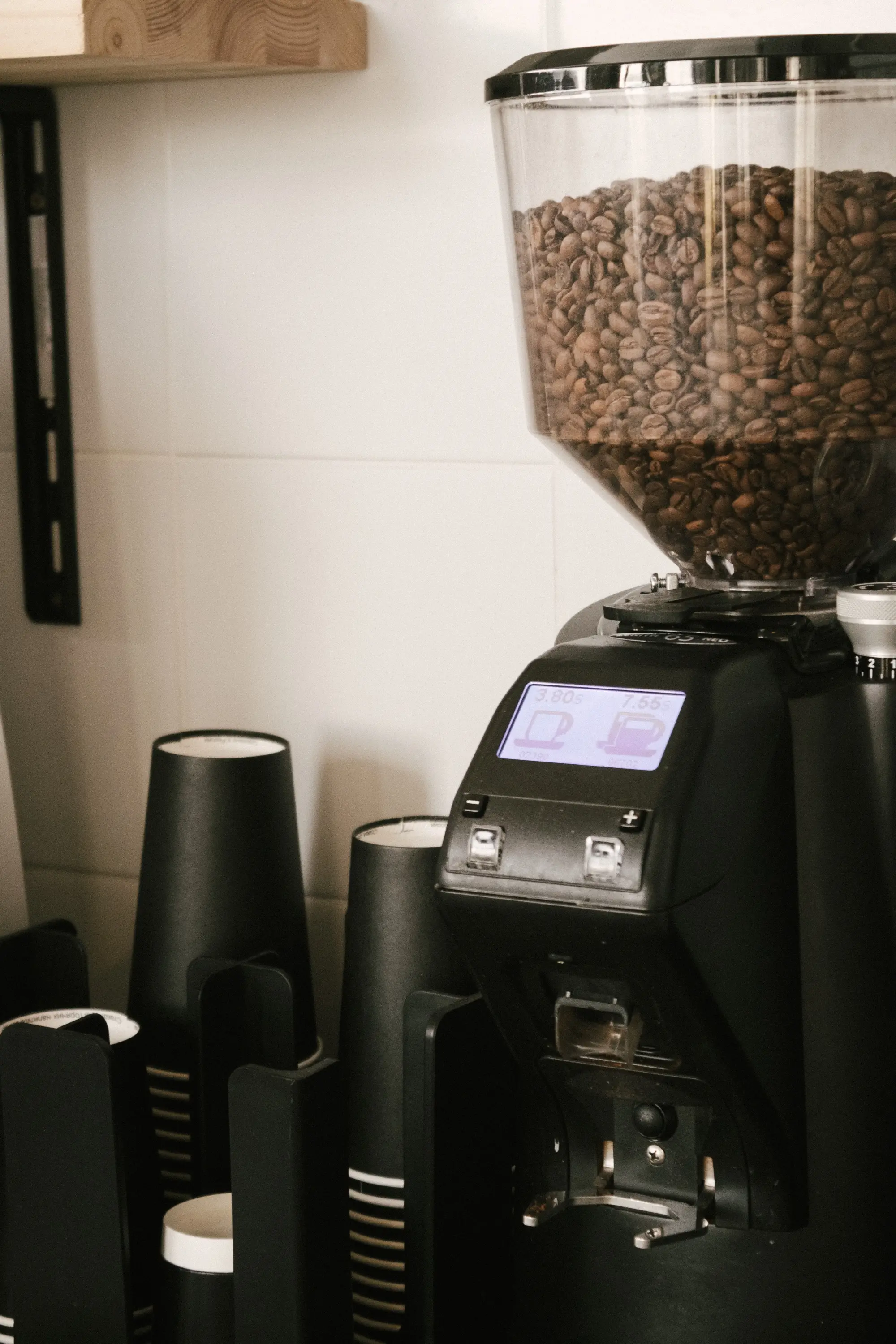
At UK prices checked on 21 September 2026 these two cost the same to within a pound, and they ask completely different things of you afterwards. One hands you a portafilter, a tamper and a steam wand. The other froths the milk without you holding the jug.
The machines are the Sage Barista Express SES875, sold in the UK as the Milk Jug Thermal bundle, and the Ninja Luxe Café Premier ES601UK. Sage’s is sold as the Breville Barista Express BES870 outside the UK.
Where they differ
| Sage Barista Express SES875 | Ninja Luxe Café Premier ES601UK | |
|---|---|---|
| Width x depth x height | 318 x 351 x 404 mm | 336 x 344 x 372 mm |
| Weight | Not published | 17 kg |
| Bean hopper | 250 g | Not published |
| Grind settings | 16 | 25 |
| Burr material | Steel | Not published |
| Heating system | Thermocoil with PID temperature control | Not published |
| Pump pressure | 15 bar | Not published |
| Portafilter | 54 mm, single and dual wall baskets | Size not published, three baskets supplied |
| Milk system | Manual steam wand | Automatic froth system, four presets |
| Rated power | 1850 W | 1800 W |
| Switches off after | 30 minutes | 20 minutes |
| Water filter | ClaroSwiss, every 90 days or 40 L | XSKFLTRINS6EUK, every 2 months |
| Descaling interval | Every 90 days at hardness level 4, every 60 days at level 6 | Not published |
| Warranty in the UK | 2 years | 2 years on registration |
| UK price range, 21 September 2026 | £499.95 | £499.00 to £499.99 |
They share more than the price. Both are espresso machines with a built-in conical burr grinder, both hold 2 L of water, both come with a tamper, and both are cleaned with a cleaning disc and tablets. Spare parts and filters are sold for each.
Read the “not published” rows as part of the answer. Ninja states no pump pressure, no heating system and no portafilter diameter for the ES601UK, so there is nothing to line up against Sage’s figures. Sage in turn publishes no weight, while Ninja gives 17 kg, which matters if the machine comes on and off a shelf. Neither maker publishes a warm-up time or a noise level.
Counter space
The Ninja is the wider machine at 336 mm and the Sage the taller at 404 mm, a 32 mm difference in height. If the machine lives under a wall unit, that is the number that decides it. The Sage is 7 mm deeper. In plan view the Ninja takes about 1,156 cm² of worktop to the Sage’s 1,116 cm², so height and the milk routine, not area, will settle this.
The milk system is the real fork
On the Sage you texture milk yourself. Sage’s product page calls it “manual milk texturing”, and the Barista Express instruction manual sets out what follows: “The steam wand should always be cleaned after texturing milk. Wipe the steam wand with a damp cloth”, then clear it with a short burst of steam over the drip tray. If a tip hole blocks, the manual has you switch off, cool down and “use the pin on the end of the provided cleaning tool to unblock the hole(s)”.
On the Ninja the milk work is handed over. Ninja’s product page describes a “Hands-free Dual Froth System: Steams & whisks milk at same time with 4 auto presets”, using a jug with an integrated whisk. Ninja’s owner’s guide for the ES600 series gives the cleaning that comes with it: “The machine will automatically purge water from the steam wand into the main drip tray after each froth. This is to clean the inside of the steam wand.”
That purge has a cost you can plan for. The same guide says the main drip tray “is designed to hold the water bypass from the creation of up to 6 cappuccinos”, so the tray is emptied roughly every six milk drinks rather than when it looks full.
Dishwasher or sink
The two manuals give opposite instructions, and this is the line most likely to change someone’s mind.
Sage’s manual says of the Barista Express: “Do not clean any of the parts or accessories in the dishwasher.” Everything is a sink and cloth job, including the filter baskets and portafilter, which the manual says should be rinsed under hot water straight after use.
Ninja’s guide lists the opposite: “Dishwasher-safe parts: funnel, whisk, cleaning disc, water reservoir, bean hopper, and all drip tray components.” The milk whisk and the water tank going in the machine matters if washing up is the thing that stops you making coffee.
Cleaning cycles and descaling
Both run a backflush-style cleaning cycle with a tablet in a disc, and both signal it with a light rather than a date. Sage’s manual is explicit that “the clean me light will illuminate when a cleaning cycle is required. This is a backflushing cycle and is separate from descaling.” Ninja’s guide puts a clock on its own two: a clean cycle takes “approximately 6 minutes” and a descale “approximately 90 minutes”.
Descaling frequency is published for one machine only. Sage recommends descaling “every 90 days when water hardness is at level 4” and every 60 days at level 6, with Sage Descaling powder. Ninja publishes no interval, only the descale light, and its routine allows either the supplied Ninja powder or white vinegar to the Descale line. The vinegar is Ninja’s own instruction, not a home remedy, and it appears in Ninja’s guide and not Sage’s.
Filters follow the same pattern. Sage’s ClaroSwiss filter is replaced “after 90 days or after 40L”, a volume as well as a date, and the maker states it fits SES875 from batch 1735 onward, so check the batch before ordering. Ninja’s filter six-pack covers the ES601UK on a two-month cycle that the guide asks you to date yourself.
Which one
Choose the Sage Barista Express if you want the published numbers: 15 bar, a thermocoil with PID temperature control, steel conical burrs, a 54 mm portafilter and a descaling interval tied to water hardness. You are accepting a hand-wiped steam wand after every jug and a sink-only cleaning rule.
Choose the Ninja Luxe Café Premier if the milk should look after itself and the parts should go in the dishwasher. You are accepting that Ninja publishes no pump pressure, no heating system, no burr material and no bean hopper capacity, so several of the specs you might compare simply are not there.